









What is a Master Service Agreement (MSA), and How Does it Work?

These are two important questions for any service delivery business. We cover these vital topics, as well as “What is a master service agreement used for?” in the article below.
Although they are used across various industries, if you work in the IT field, it’s even more essential to understand the importance of MSAs. As stated by a survey conducted by Gartner, over 60% of IT companies use these valuable document types. This statistic makes sense to us, since IT companies do need a formal way to manage their complex business relationships and services.
So, are you keen to learn how to create a professional MSA template that has structure and is well-formatted? Keep reading. We can fill you in.
Let’s get started.
(MSA) Master Service Agreement Definition:
MSAs serve as a contract between two or more parties. Within it, you will find the terms and conditions that state how interactions and transactions will be conducted by the parties in the agreement. MSAs are usually used when business partners want a long-term relationship.
It is an ideal agreement for business-to-business relationships that interact with each other frequently because it can cover many joint projects or sales between the parties for a long period of time before the terms and conditions of the MSA need to be renegotiated.
Why is it Important to Have a Master Service Agreement?
There are many reasons why businesses should have an MSA in place. One of them, is that an MSA covers the scope of services performed by the parties in the agreement. Adding a clear Scope of Services section to your MSA should be a top priority.
It will inform each party in the agreement of what they will receive and what they owe in return. Including these business arrangement expectations is a key way to ensure everyone understands the following elements of the service:
- The Nature of the Services
- The Extent of the Services Delivered
- The Limitations of the Services
When Should You Create a Master Service Agreement?
If your business wants to:
- Speed up a contract lifecycle management process.
- Collaborate with a business partner for an extended period of time.
- Quickly start new joint projects with business partners using regular pre-established terms and conditions of previous agreements.
Whenever you put together an MSA, you can save time and reduce legal fees for your business, as you do not need to renegotiate general terms and conditions for every new project with your partner.
Master Service Agreement Checklist: What Should Be Included?
Since MSAs have major parts of a business agreement, it’s best to make sure that you add all of them before it is signed and finalized. You wouldn’t want to accidentally leave out certain details of an arrangement. For this reason, a checklist is a crucial tool that can be used in MSA creation.
Here is a general MSA checklist that you can take and modify to your specific business needs:
| Sections of an MSA | Description |
|---|---|
| Scope of Work | Describes the type of services performed in the agreement. |
| Confidentiality | Explains how confidential information will be protected in the agreement. |
| Location | States the geographical locations where the services will be performed. This section can also name where the MSA applies. |
| Product Delivery Requirements | Identifies the expectations for the products on arrival and how they will be delivered to a party. |
| Work Standards | This section defines the quality and performance of the party rendering services in the agreement. |
| Intellectual Property Rights | This section describes who owns the Intellectual Property and how it can be used. |
| Payment Terms | Details all the payment information for services, such as payment dates and invoicing cycles. |
| Taxes and Fees | This section sets out each party’s responsibility to pay taxes and any other fees for services. |
| Limitations and Liabilities | Frames each party’s financial and legal responsibilities in case of a breach of the MSA. |
| Revenue for Legal Obligations | Details how compensation, payment terms, and revenue-sharing will be performed. |
| Warranties | Lists all the guarantees for quality and performance of services and products from each business. |
| Insurance Requirements | States the type of insurance coverage each business has signed up for. This section will also show the costs of the insurance packages in the agreement. |
| Termination Clause | Informs parties about how the MSA can be terminated. This section also provides notice periods and penalties for termination. |
Master Service Agreement Example
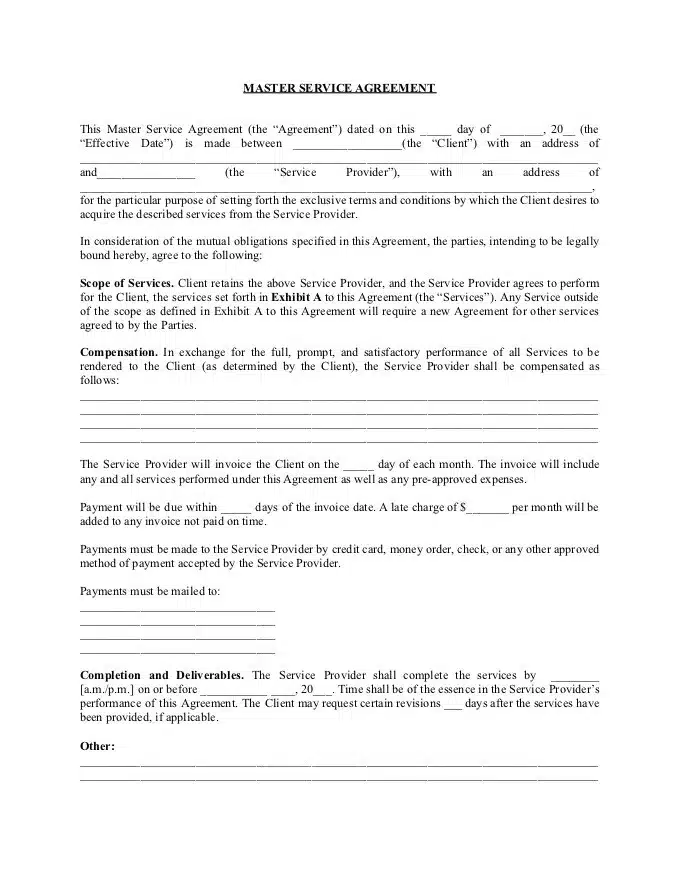
Images speak volumes! So, here is an example of a simple master service agreement template in the real world.
Create, Edit, and Sign Master Service Agreements with TITAN for Salesforce
If you are in the market for software that can automatically generate MSAs from Salesforce, we suggest you check out Titan Docs. Our no-code platform integrates directly with Salesforce and connects to Microsoft Word so that you can create and edit any Master Service Agreement with your CRM data. We believe we can help you save time and reduce the amount of errors you could make when creating MSAs from scratch each time.
Here are a few features you get from Titan to quickly build accurate MSAs:
- Point-and-Click Tools to generate MSAs as pre-filled PDFs directly from Salesforce.
- Use Titan to build other document types, such as custom contracts, proposals, quotes, and invoices directly from Salesforce
- Merge and convert your files into any document format you need.
- Titan can read any field from Salesforce objects and reports and display it in a format of your choice.
- Add interactive elements to your MSA to write data back to your Salesforce objects.
- Titan works with standard and custom objects or any data structure in your system.
- Automate business processes from start to finish using drag-and-drop tools that require zero coding knowledge.
- Add e-signature fields to your MSAs to allow all parties to sign documents online to reduce time-consuming tasks.
- You get more document-storage options as Titan can move your files to other locations, such as Google Drive or Box.
- Titan is secure and compliant with HIPAA, SOC 2, ISO, GDPR and other leading frameworks.
Peace of Mind with Titan and Salesforce
You want your Master Service Agreements to be valid and accurate so that you can continue with daily operations that drive business growth. Opting for intelligent software, like Titan, coupled with a premium customer relationship management (CRM) platform, like Salesforce, can help your business reduce data entry errors in your MSAs. Say goodbye to incorrect date inputs and problematic formatting issues.
For more information on how to upgrade your MSA process to create and sign agreements while storing them in any location you choose, contact us through one of our social media links below. We would love to help you step-by-step with a custom Salesforce process that meets your unique business needs.
Disclaimer: The comparisons listed in this article are based on information provided by the companies online and online reviews from users. If you found a mistake, please contact us.
You might be interested in
Writing Your First Notarized Letter Like a Pro

How to Remove Track Changes in Word

Signee Vs. Signer Vs. Signatory: What are They?

All-in-One Web Studio for Salesforce