







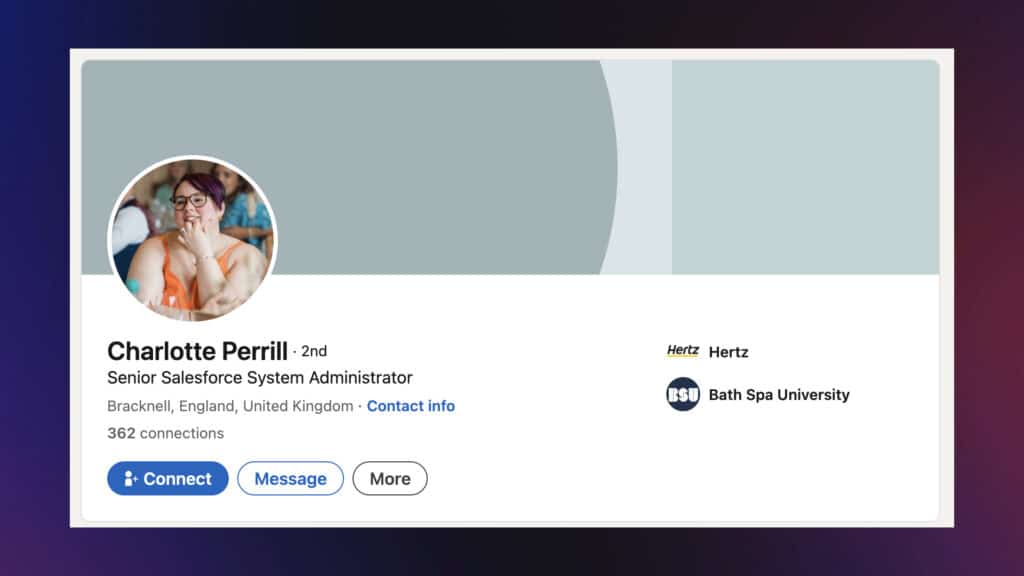
Spotlight on Charlotte Perill – Senior Salesforce System Admin

Welcome to Salesforce Radio, your destination for insights, news, and community connections within the dynamic Salesforce ecosystem!
In episode 8, Ben Miller chats with Charlotte Perill, a Senior Global Salesforce System Admin. Charlotte helps professionals across different departments at Hertz work more efficiently within Salesforce, thanks to her expert automation solutions.
Charlotte works in Salesforce daily and can give you a perspective on how to elevate the experience for users in a large organization! Keep reading for all the highlights from this podcast, and find out about Charlotte’s career in operations, as well as what she is excited about from Salesforce in 2024!

Ben: Welcome to Salesforce Radio. I’m here with Charlotte Perill, the Senior Global Salesforce System Admin for Hertz.
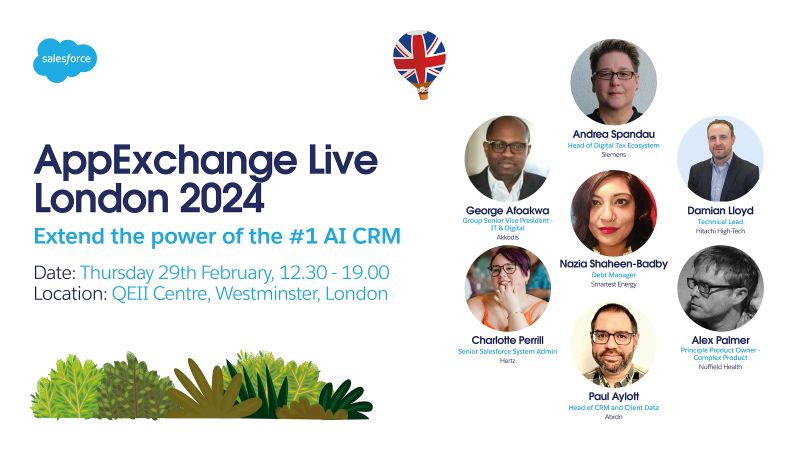
Charlotte and I met briefly a few months ago in London at a Salesforce AppExchange live conference. Later in the day, I heard Charlotte speaking on behalf of her company.
So, Charlotte, nice to meet you. Thanks for joining.
Charlotte: Thank you for having me. It’s lovely to see you again.
Ben: It’s always fun to meet people in person and then reconnect online. In the last couple of years, it’s been the opposite. I get to know people over Zoom, and then I meet them in person.
Just to get started, I’d love to hear about yourself and your journey into the Salesforce space. Then, we could talk about what you’re doing and what other people should do after hearing this podcast.
Charlotte: Like most people, I accidentally fell into Salesforce. I’ve been with Hertz for 14 years now.
I started in operations. I worked through the business from the bottom to where I am now. I learned a little bit about the cars themselves, the customer experience, and so on.
We implemented Salesforce for our usual B2B sales journey, so opportunities, contacts, etc. My predecessor from my original Salesforce role left, and my boss came to me and said, “You’re smart. Work it out.” I said, OK – that’s great!
So, I became the internal sales lead for Salesforce, supporting the international business of everyone outside North and South America. I was looking after 400 people across the globe for different corporate markets.
Then, my current predecessor retired from Hertz, and my current boss, Julie Cooner, asked, “Do you want to join my team?”
That’s how I became a senior admin. I’d got my cert for December before I started, and I’ve been doing this as my full-time gig for nearly two years.
Ben: So, when did Hertz go live with Salesforce?
Charlotte: Initially, it was just for B2B. It replaced Navigator. I don’t know if any of your listeners have been in sales for 1000 years like I have, but Navigator used to be the B2B contract mapping tool before it retired. From 2020 onwards, we moved all of our loyalty into Salesforce.
Our core environment has nearly 3000 users and holds data from customer care, B2B, and loyalty programs. It’s everything except for marketing that sits in this one little space.
Ben: When Hertz implemented Salesforce, you had already been with them for a long time. What were you doing in operations?
Charlotte: I used to work as an in-house, which means I’m working for Hertz inside a customer’s environment. I also worked at the BBC desk, where I did all the car rentals for them. We used to do:
- Bookings
- Billing
- Customer Fines
- International Rentals
We are one of the few brands that is truly global. There are very few places we are not as a business, so helping folks on their international travels was also part of my job.
Ben: I don’t have a true sense of what operations is. Operations are very broad, but you were in the trenches doing coordination. I see that was probably a lot of:
- Picking up the phone
- Interfacing with people
And then, suddenly, you’re inside of a system. That’s a big transition.
Charlotte: You go from an environment that’s not shouty or aggressive to one where people need a car here or there. It’s constant noise.
Moving into a sales and system environment, the volume of noise is low. Everyone is chill, and it’s a lot smoother. It’s my preferred environment.
I’m a dyslexic person, so when there are times of quiet, I enjoy it.
Ben: I can hear that. For me, I went from working in an office to being remote. I am the opposite. I like bouncing ideas off people, but I’ve adapted.
When you got into Salesforce. What were the first things you jumped into? Did you do any training? Did anyone hold your hand through the beginning?
Charlotte: We went live in 2016, and because I was an end user, we had extensive training. Salesforce trainers trained the super users. It was the train the trainer model, so we had a small group.
There were 10 of us, and fortunately, we had a trainer who spoke multiple languages. It didn’t all fall on me to translate for everybody. I was very grateful because I was learning a new system.
However, when I moved into my sales-specific role, I had two days with my predecessor. Then, it was off you go, see how you get on. That was great and interesting because I was an end user. I understood the pain-points.
It was nice to have those quick wins listed to make adoption better. At the time, Salesforce was another tick-box exercise. But it’s not, it’s really important.
We needed the teams to do what we’ve been asked to do so we can be compliant. Salesforce is a system of truth that we are audited against. So, if your contract doesn’t match what you’ve put in Salesforce, you’re in trouble. Explaining this to them was really helpful.
When I moved into my current role, I had two weeks of changeover with my predecessor. I learned all the nuances. You can’t move on if you don’t have what you need.
So, that’s my training, along with the Trailhead bits when I could. I’m currently working on my app builder.
Ben: Oh, good. It’s hard to find the time to do Trailhead and learn more, especially when spending so much time inside the system.
Was there a turning point for you? Was it through seeing the complexities and user issues in the beginning that you started to believe there could be something good in this? Was there a mind shift there?
Charlotte: That was a mind shift. I’ve been doing something by hand for two years because that’s how it gets done. All businesses have these processes. But it was time for change and to move forward.
When I was doing this process manually, I noticed a report function out of Salesforce that would save me hours throughout the month. I decided to see if anyone noticed I’ve automated this and said anything. Nobody did.
As new people joined the environment, I trained them to do it automatically, which saved us hours of time. It turned into a happy little environment of sales for folks. Some of my reports still exist. They are automated and are still used.
Ben: Wow. The first thing you built in Salesforce was a report. I like that because the value that an organization might be getting out of Salesforce is for the shareholders and the board. But it’s a huge leap when you see that we can empower the end user by creating better reports and automating tasks.
It’s a big deal that we can suddenly have this kind of different experience. To my question before, you’ve now turned to the other side, where the system can make life better.
It’s a great story for Salesforce because it doesn’t always get adoption. It all comes down to implementation and evangelism inside the organization. It’s cool how you fell into that role.
Charlotte: It is by accident. I remember asking a colleague, do you want to spend two hours doing this? If not, you can learn to do this in two minutes. I don’t want to spend time doing it, so I will get something else that does it for me.
So, why not make life easier for everybody? There are far more important things that we could be doing.
Ben: In my experience as a salesperson, selling software which makes Salesforce easier because it allows for more interaction from customers, partners, and anyone outside the system through forms.
I always hear about customer pain points. The validation is tough, or they have failed submissions. These issues come along with these types of software or use cases, especially when you’re interacting with a diverse group of individuals who are putting information into your system and signing up at their different locations.
We all know that it’s still a problem for many people, whether they’ve been on Salesforce for a month or 75 months. Some things are not making their users’ lives easier. Maybe the users or admins don’t say anything.
What do you do in your organization to improve things like this? Is there a Help Desk?
Charlotte: It’s a two-fold thing. We have our ticketing system.
We also have a high-profile team that is part of the CRM team. If you have a problem with the CRM, you tell us, and we try to find a way forward. It can be the smallest or biggest thing.
If you have that open dialogue with end users and a way to bring the information to your CRM team, that’s how you get people using the system.
If you just leave them to gripe about it in the background, they’ll say the system the business has implemented is rubbish because no one’s heard them.
I’m fortunate because I have been with the business for a long time. I know many people, and I pop into people’s chats. I ask if they have noticed that something’s been going on. There’s back-and-forth. Our business unit heads across the different sectors within our core environment are also vocal.
The main message I send out is if you tell me it’s broken, I will fix it.
Ben: Coming from the business, you know what people are doing daily. Tell us about your current role and what your daily life looks like?
Charlotte: No day is the same. I’m one of the senior global system admins for Salesforce at Hertz. Daily, I look after 3000-odd folks.
I manage their access and provisioning and make sure they can see what they need to see to do their day-to-day job. But it’s not just that. I look after everything:
- Provisioning
- Security
- Data Management
- Health Scores
- Everything from Top to Bottom
I’ve got my hand everywhere. If I don’t like the score on the health check, Jira cards get graded, and we can move forward. We like to have a healthy score, but it’s not just across our core environment. I also look after Ask HR and Marketing Cloud.
I also spend a lot of my time in meetings advising, not how they do it internationally, because I used to work for the international part of the business. I speak on behalf of our corporate international markets and remind the US because it’s a US business.
For example, there are no “states” in the UK or New Zealand. That’s not how postcodes look over here. It’s not about being negative. It’s so we have user adoption. If we’re trying to fit a square peg into a round hole, the data’s gonna be no good.
That is my day-to-day in Salesforce. I spend a lot of time reviewing people’s permission sets, ensuring they don’t have too much access when they shouldn’t.
We’re currently onboarding a new business sector, so I’m spending a lot of time making sure colleagues are trained and everything’s working.
Ben: In terms of your team and resources. It’s a big corporation. There are different teams and budgets:
- IT
- Operations
- HR
Then, there’s Salesforce. Where does Salesforce sit within the organization? And what does your team look like?
Charlotte: At the moment, we are sitting under the tech and product umbrella. I interact predominantly with my fellow senior system admin, and she looks after the loyalty side of things. Between us, we know everybody.
I spend a lot of time with our product managers. They support teams in business like:
- Sales
- Care
- Marketing
Then, I spend a lot of time with the senior team, going over their expectations, like what needs to go out in the release. I support the release closure after release day. So, making sure businesses are confirmed, everything’s working, and that we can close out in a timely fashion.
Those are the folks I interact with. Our team is not enormous. We are a close, tight knit team. We all support and train each other. We have wonderful developers who are insanely talented. What they don’t know about Salesforce isn’t worth knowing.
I love the whole team, they are amazing. We also have some seasoned Salesforce veterans in our midst. Marlene has 10 – 15 certifications. One of our other senior team members, Brian, also has a similar amount. Our devs are all highly trained and decorated. So, we are a very knowledgeable team.
Ben: It’s fun to work with people you can learn from and rely on for different things, especially in Salesforce. These are people who can see the big picture. I have appreciated that from colleagues I’ve worked with at Titan, who were born into Salesforce. That’s where they came from. It’s nice to have colleagues that know so much, and they get that big picture.
Charlotte: They’re incredible because they don’t hold information from you. We have open dialogue, so there’s always active training to move everybody forward. At the end of the day, we’ve all got one pair of hands and so many hours in the day.
If someone wants to help you out or you think someone can support you with something, you just share that information.
Ben: I can definitely relate to that. What are some of the milestones of the implementations you’ve done up until this point?
Charlotte: Our archiving strategy has been one of my favorite things to work on. Did you see my talk at AppExchange? I’ve also given the same talk at Dreamforce.
I had my logons for two weeks, and then we had an archiving policy that got a little overexcited. Working out those new policies and making sure all 600,000 records were brought back in a timely fashion was a project.
The knock-on effect from that project is now part of my daily life. I make sure all the archiving policies are running, we’re not going over storage, and everything’s moving as it should be.
It’s really valuable and important. I find it business-facing because they need their data, but we also need to archive it and make sure we can do what we need to do.
As with most businesses and digital transformation, we’re making things easier for our care agents. This transformation will make supporting customers easier.
There are always ongoing projects, and they’re my favorite activities. They’re time-consuming, though.
Ben: That’s how it goes when you’re in an agile environment, which sounds like you are. You don’t get stuck in planning projects for exorbitant amounts of time.
That’s nice to hear, at least from the perspective of someone who’s working in a tech company. It’s a different environment, where everything tries to move fast all the time, and there’s no expectation that anything’s gonna ever be slow.
Charlotte: Some things move at a quick pace. Some things are unavoidable. When you need to go from 0 to 100, that’s fine. Some days are like that. And then there are some projects that you dance around for a while because you know that you need to do this project. But there are also six other things that it’s dependent on.
If you can’t do the six things, you can’t do the project. Then, someone doesn’t like the six things because the legal team has decided they don’t like something, and you have to return. Some projects are like this, and that’s fine. That’s the nature of the business.
Ben: Absolutely. What are some of the things that you have coming up in the near future? What’s on the road map for you guys?
Charlotte: It’s the continual digital transformation: making sure our care agents in the call centers and at the desk have everything they need.
It’s continuous improvement with Salesforce, too. We can customize most things, and we have. My other half works in a different sector. They use Salesforce. And he happened to peek over my shoulder since we work from home. He mentioned that’s not Salesforce! I replied, Oh, yeah, it is.”
Our Salesforce is bright yellow. We love it because that’s our branding. If I look at his environment, it’s entirely different.
It’s nice to have a customizable kit that you can make future-proof. We know that AI and chatbots are important. We’re building those blocks to make sure we can do business in that fashion in the future, which is great. It means I get to play with things.
Ben: As someone who talks to businesses of all shapes and sizes, from small nonprofits to large multinational corporations, I think the smaller organizations benefit from creating a look and feel that will improve the day-to-day Salesforce tasks for users.
Seeing your company’s colors is not a difficult thing to implement, but it can make a big difference. I also had one instance to peek over someone’s shoulder who works for a large company, and it it really was like that.
That’s what you can do when you have resources, vision, and a road map. You want to provide these. It was eye-opening because as someone who uses and sells Salesforce solutions to users inside and outside of the CRM, it was cool to see where you could take things and what those limitations were.
That’s something you have pride in at Hertz?
Charlotte: Definitely. It’s your coffee system:
- You sit down at your desk
- You’ve got your coffee
- You turn on your emails
- You turn on your Teams and then Salesforce
These are the top things you should be doing first.
I can’t guarantee all teams are going straight to their dashboards, looking at where things should be, and moving things through because that’s not how sales teams work. For some environments, B2B needs to take a break.
But with care, it’s emails, chat, and Salesforce. That’s how the day starts, and that’s how the day goes. They are in it all day. They get annoyed if they’ve been doing something else for a few minutes, and Salesforce locks them out. That’s the security feature we have turned on because it is our system of truth.
You can’t just walk away from it for 10 minutes. You have to keep using it. That’s the policy, and it’s the thing I get asked about the most. For example, “Can you extend the time?”
It’s good to know that they’re using it, and that’s a frustrating point for them. I’d rather they be frustrated with that than it not working. I can put up with slow runtime because that’s not our fault.
If Salesforce is locking you out because you went for a coffee and came back, I’m happy with that because you wanted to be back in it. But I’m not happy that you didn’t close it down before you went off.
Ben: I’d love to dig into that. Tell me about taking this care role. What do they see in Salesforce? What does the Home screen look like for them? What are you pushing them to do when they log into Salesforce, and what are the main things they do there?
Charlotte: It’s different per user group:
- Sales
- Security
- Finance
- Care
- Additional Services
We’ve moved things around in the App Centre where people are directly pointed toward their part of the environment, so sales will always see sales at the top. Care will always see care at the top because they shouldn’t be playing with anything else.
It also depends on whether they’re working on cases, answering phones, working with Omni, or working with a specialized customer that day.
For Sales, when they log in to Salesforce, I don’t want to call it the standard Home screen because we have updated it. They see pending approvals and tasks that they are meant to be doing that day.
We also have Salesforce Inbox. That’s a good tool they use for upcoming appointments. They are always close to a link to a dashboard that says, “This is where you’re at.”
That’s what we point people towards. And security. I’m not saying they have free reign of the system. They need to be able to see a lot of things, so we make sure they can see all the things they need to see, and if they can’t, I get poked.
We have completely customized Salesforce. It’s bespoke to your business unit, making sure that you can get to where you need to be.
Ben: And are there business units that are still not on Salesforce?
Charlotte: Everybody who needs to be in Salesforce has access. That’s for sure, but I get requests for access all day, every day. I’m not saying they’re heavily policed. The type of access they require is heavily policed.
Our approval process is robust, and my boss and I have the final call. When it gets to us, everyone who should have decided they didn’t want something should have done it. If they haven’t, I’m happy to press that reject button.
Ben: I like the point about security where people need access. They don’t have to start pulling papers out of the old drawer. They have faith that information should be on Salesforce. So, they come to you to get access. That speaks volumes about the level of competence the org must have.
Charlotte: We had something come up the other day. One of our heads of security wanted to search for particular criteria, but the search criteria were pinned to three points.
Sometimes, if you work in security, you have only one point of criteria. We’re looking at a way to remove two points for this user group so they can search better.
It is important because they see Salesforce as the system of truth. They want to be able to search by that criteria. It’s completely invaluable to most departments.
Ben: It sounds like there’s cohesion, and that’s nice to hear coming from someone who’s in the trenches of the system, looking at all the parts and working with the different people involved.
Before we wrap up, what are some of your thoughts about where we’re at right now with Salesforce? It’s always fun to check in 8 months later and ask, “What’s going on? And what does the rest of the year look like for people who live inside of this Salesforce ecosystem?”
Charlotte: I’m excited about the move into AI and how we can use generative AI as Salesforce users, not necessarily as someone who works for Hertz.
I find it interesting how AI can learn from us. Is it going to correct me as a dyslexic person or is it going to learn my idiosyncrasies?
I cannot wait to play with that in the sandbox to see how it learns, whether it learns from me, learns from external sources, or corrects itself.
I also speak a few languages, so teaching it in different languages I find fascinating because I’m terrible for it. My mom is French and Italian, so we switch between three languages. It’s funny to watch, but will AI learn in a similar fashion?
I’m looking forward to those enhancements and seeing what we can do with it.
Ben: I had this talk with Mark Good, who was in the podcast. He’s from AI Force Training and we were talking about how there was this jump on the scene from ChatGPT. It all of a sudden was exposed to the masses, and the hype has died down a lot now.
What we’re seeing now is that people are starting to internalize, understand, and take in-house these new tools. They are starting to play around and see where they’re going to come into our lives within and outside of Salesforce.
Every type of conversation you have about AI is different, right?
Charlotte: As a personal thing, I’d love to integrate AI with a flow process that can make changes to approvals. If it can take into consideration a wide set of parameters and approve or reject itself based on the parameters. I love that kind of thing because my background was sales.
I have always thought that part of Salesforce is fascinating: seeing how far you can get with the flow and automation. If you added a sprinkling of AI, you could save yourself a lot of time.
Ben: That’s what I was thinking about. In different ways, where could we improve things a bit? Take out one step, or do one thing better with more accuracy and data. That’s the idea, to be able to work with a much bigger data set.
I could cover in an hour, 10 hours a week. I can’t consume as much data as the computer and AI.
Charlotte: We’ll just let AI do it, after setting it and letting it run. I love leaving things to think about themselves. I’ve worked with a couple of data sets independently.
I love D&D and tabletop RPGs. I’ll load a set of criteria into ChatGPT and let it roll out the scenario.
It’s fascinating to see where you end up as a person, a character, or the people you’re playing with versus what the AI has binned out.
Ben: Oh, that sounds like a cool thing to try out. Before we wrap up, do you have any advice for people listening to this who want to further themselves within the Salesforce ecosystem?
Charlotte: My biggest advice is to join your local community. All communities are welcoming. They are beautiful communities that are available either online or in person. Having camaraderie within the groups is amazing.
You can discuss your certs, which is important. We all have to do our cert maintenance. It’s one of those things. I hope everyone has met the deadline already, as the new one has come out.
It’s valuable to have those discussions with people face-to-face because you can find new routes or support on how to best do your certs.
I’m lucky. My mentor is internal to Hertz. But I also recommend finding a mentor within your community. Should you be able to find the right community for you, it’s good to reach out to someone and ask for mentorship for support, growth, and guidance.
As long as you have a good goal in mind, then they’ll be able to support you.
If you are an active admin, please back up your data. It doesn’t matter what backup solution you are using. I will always recommend Own. They are one of the best and the ones we use at Hertz. The service and product are amazing.
Just because other people have data losses doesn’t mean you won’t. That’s my main advice to folks. And just enjoy Salesforce for what it is. It’s a wonderful environment. Trailhead is amazing. It’s a beautiful space to work in.
Ben: Charlotte, we’ll leave it at that. Thank you so much for joining us on Salesforce Radio. It has been an absolute pleasure, and I look forward to getting together again.
Charlotte: Thank you so much.
*Note: This article is an edited transcript of the interview with Charlotte Perill.
Salesforce Radio
Thank you for reading the highlights of this Salesforce Radio episode. Don’t forget to follow us for more exciting discussions, expert tips, and exclusive interviews with industry leaders.
Stay connected with Titan, plus the power of the planet’s leading CRM.
Disclaimer: The comparisons listed in this article are based on information provided by the companies online and online reviews from users. If you found a mistake, please contact us.
You might be interested in
Writing Your First Notarized Letter Like a Pro

How to Remove Track Changes in Word

Signee Vs. Signer Vs. Signatory: What are They?

All-in-One Web Studio for Salesforce