








What is an MOU Agreement?

It’s a formal, non-legally binding agreement between two or more entities. Within a Memorandum of Understanding (MOU) agreement, one can find the following information:
- Terms and Conditions of a New Business Partnership
- Details of the Collaboration
Want to hear how teams are focusing more time on sales than on creating documents? Watch the video below.
According to MasterClass, up to 60% of private-sector businesses create MOU agreements in the partnership negotiation phase. This makes sense to us since MOU agreements provide precise details of each party’s responsibilities and what they can expect from the partnership. Only when everyone is happy can the partnership move forward to create a legally binding contract.
Keep reading if you want to know more about an MOU agreement and how to generate documents seamlessly from Salesforce. We dive deeper into these interesting topics below.
MOU (Memorandum of Understanding) Agreement Meaning
We have already defined an MOU agreement, but what is the purpose of creating these documents? Essentially, they are designed to formally explain that parties want to work together. MOU agreements are drawn up to provide all parties with clear information regarding:
- The Roles of Each Party
- The Responsibilities of Each Party
- The Expectations of the Partnership
How Does an MOU Agreement Work?
It works best as a roadmap to guide all parties in a partnership in achieving a project’s goals. An MOU agreement offers great flexibility, as either party can renegotiate terms and conditions before signing a formal contract.
What Should Be Included in an MOU Agreement?
As MOU agreements are used in many sectors, like business, technology, and international relations, they should describe in detail the partnership that parties will enter before drafting a formal, legally binding contract. Here are the key parts that need to be added to an MOU agreement:
- The purpose of the partnership and the objectives each party wants to achieve.
- The roles and responsibilities of each party in the agreement.
- A timeline of the partnership and any deadlines for the joint project.
- Clauses that keep sensitive information protected and confidential.
- A section that explains how each party can terminate the agreement.
- Paragraphs that address how parties should resolve conflicts.
Pros of an MOU Agreement
MOU agreements often appear in tech, pharmaceutical, or any partnership that wants to enter a long-term project that requires collaboration because they provide clear communication and direction to all parties. Here are a few more pros of drafting an MOU agreement:
- Both parties experience an additional precursor phase in the partnership before entering a solid formal agreement that is signed.
- All parties have a reference to the scope of work they have committed to. This helps to clear up any confusion on deliverables.
- It’s not a legally binding contract. Therefore, if the parties want to renegotiate the terms and conditions of their agreement, they can do so flexibly.
Cons of an MOU Agreement
Although MOU agreements set a good foundation for a partnership, they need additional information to solidify the business arrangement. Here are a few cons you might encounter from only working with MOU agreements:
- They are not legally binding agreements, so if one of the parties in a partnership breaches the contract, the other party cannot legally enforce the terms.
- An MOU agreement can be vague or ambiguous as it is not the final contract. For this reason, parties risk getting confused about what is expected from the partnership, which could result in conflict.
- If conflict arises during the partnership, there are no guidelines for how damages may be compensated, unlike a formal contract, which has legal protection for parties.
MOU Agreement Example
Before creating an MOU agreement, the parties wanting to collaborate on a joint project will meet to discuss their intentions. At the meeting, each of the parties will identify their goals, resources, and expected outcomes.
These gatherings are a “must” for creating trust between the partners. They also allow everyone to collaborate on the vision and future of the relationship.
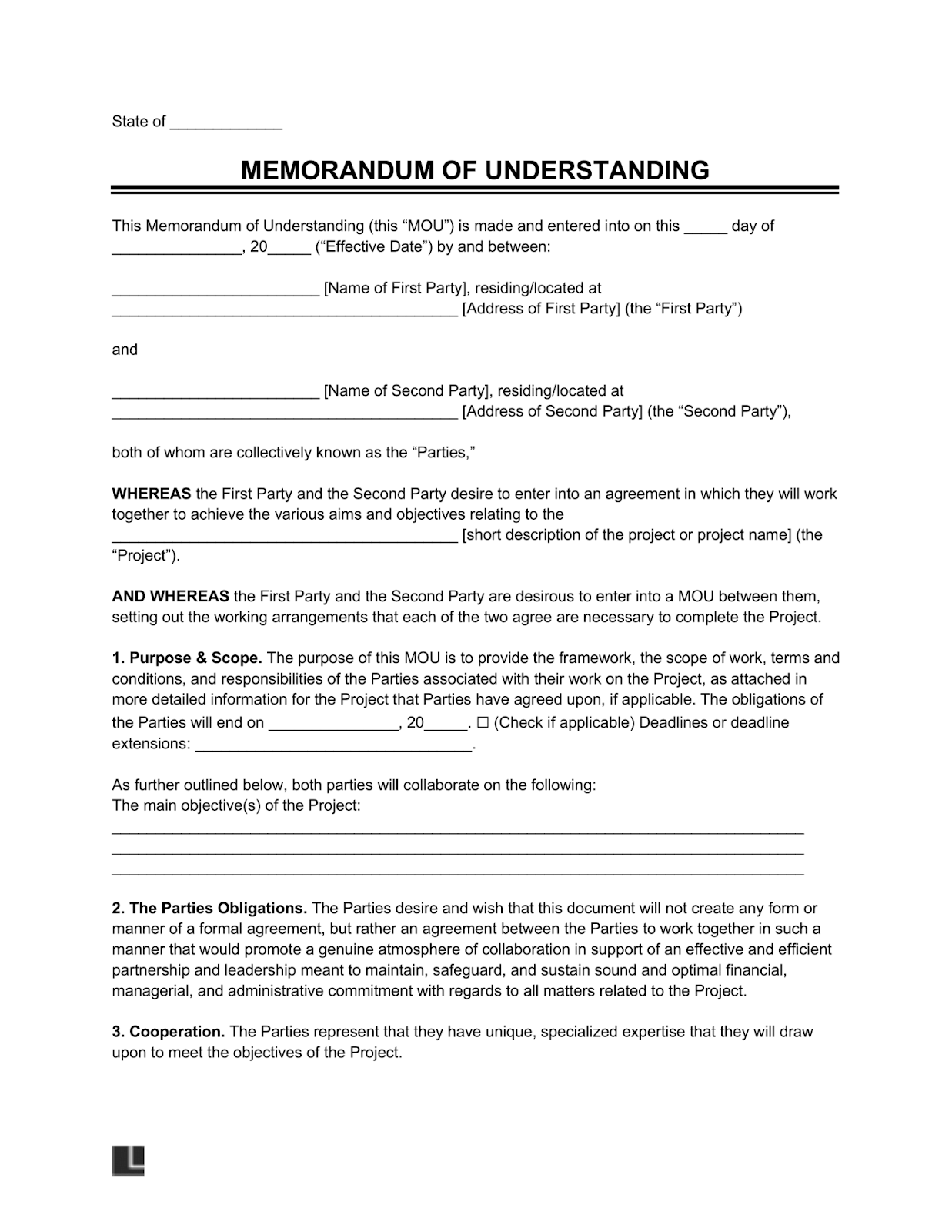
Once everyone is aligned and is on the same page, an MOU agreement can be drawn up. Here is an example of a common MOU agreement used in the real world:
Time to Implement MOU Agreements
That’s a wrap on our article about MOU agreements. We learned that even though these documents are not legally binding, they represent a serious commitment from parties to collaborate on a project.
Generate Agreements with TITAN for Salesforce
Are you ready to generate a Memorandum of Understanding agreement and any other document your business needs directly from Salesforce? We suggest that you check out Titan! Our powerful platform integrates bi-directionally with Salesforce using no code. Here are some of the features you get when you connect Titan to Salesforce:
- Build and generate documents and contracts with Titan and Salesforce without a single line of code..
- Work with multiple document formats like PDF, DOCX, HTML, and PNG.
- Add dynamic content and digital signature capabilities to your MOU agreements.
- Work collaboratively and share MOU agreements with colleagues and partners.
- Secure your MOU agreements with access permissions.
Choose Titan for Salesforce
This is just the start of what you can achieve with Titan. We have the perfect solutions for your custom Salesforce use cases. So, make sure to contact us through one of our social media channels below to maximize your experiences in Salesforce using no code.
See you soon.
Disclaimer: The comparisons listed in this article are based on information provided by the companies online and online reviews from users. If you found a mistake, please contact us.
You might be interested in
Writing Your First Notarized Letter Like a Pro

How to Remove Track Changes in Word

Signee Vs. Signer Vs. Signatory: What are They?

All-in-One Web Studio for Salesforce